October 16, 2010. That's the date on the last post.
Today is July 22, 2016. Lots of time has passed, and many things have changed.
One question still remains;
Am I a chef yet?
No, but yes.
Why not?
Of course!
We all are
My first reaction to that question is a quick no. It's an easy way out of a difficult situation, because looking within and labeling one's self is a very selfish thing to do. Selfishness is another topic for a little later.
Even now, when so many look up to me, expect answers from me, demand direction from me, I have a hard time calling myself a chef, but the term is becoming more familiar to me.
Eight years ago, I saw the term "chef" as somewhat esoteric. I saw it as a label for television celebrities, owners of high-end fine dining establishments and leaders of huge hotel and cruise line kitchen staffs. I had a hard time calling the guy cooking some french fries in a bar at 3am a "chef".
Building a Craft
Finding what i'm good at
finding what i enjoy
working with people I enjoy
Creating an environment that I enjoy
Hoping other people (customers enjoy that)
A lot has changed in eight years. I have cooked so many things. Even when i'm not cooking i'm thinking about how things I see in my everyday life relate to my craft. Cooking is part of my craft, but my craft has come to encapsulate so many different duties and responsibilities.
Linear vs. Deviation
TFL->ad hoc
fine dining to comfort food
beer!
beer and food
wine
learning about creating an experience - has not gone away
stuggling with margins and keeping costs happy
managing (directing?) people
Some days go by and I feel that there has been very little direction to my life and that bothers me. And then there's days I wake up and love the amount of improvisation I am capable of doing in my day to day life, and realize that having that freedom and doing that kind of improvisation is part of my success, and I don't get to do it by accident, I have built that into my craft.
My Team
I never thought I would say that. Even just a few months ago I didn't think I was going to have that as a topic I want to enjoy.
-What are we trying to create today?
-What am I trying to create today?
I still struggle with that, but
And being a cook for eight years by no means makes me a chef.
But isn't food fun?
Tuesday, August 12, 2025


Saturday, October 16, 2010
Call me Neil.
I haven't posted on here in a long time, and I think that's for a lot of reasons. But first, I want to get back to the main question here; Am I a chef yet?


I have been called a chef on numerous occasions, (here's a good one!) but I don't feel like one. Whenever someone calls me 'chef' I will very quickly correct them, asking them to call me Neil. I didn't really realize it as it was happening, but over the past year and a half, I think that has become one of my legacies. I'm a cook, and I always will be.
No matter what anyone says, i'm still an archaeologist, i'm still a trombone player, i'm still a kid that grew up in Connecticut and spent his summers on a cattle ranch in Oregon. I'm still all these things, and I always will be. What will I be in the future? I don't know exactly, but I have a few things that I know I would like to be. One thing for sure that I would like to be is a person that supports the people around me, whether it be friends, family, coworkers, or strangers. Basically, if someone has a question or needs help, I want to do everything I can to help.
Ad Hoc has been incredible, and now I am in the process of moving on to the next adventure. A lot of people have been asking me what I'm doing next, and the answer is; I am going to cook.
I love to cook. Some people tell you that if you love to cook, don't do it professionally because you won't like it anymore. This didn't happen to me. All i've been doing for the last two years is cooking. When I wasn't at work (Ad Hoc) I was cooking four course dinners with beer pairings with a friend at Mission Gastroclub. All I've wanted to do is cook, and try new things, and just make really good food that hopefully people will enjoy, because I enjoy making it.
This all feels really weird, telling everyone what's on my mind, but a lot of people are asking, and I guess that's what a blog is for: telling. So right now I'm looking for a cooking job somewhere in the San Francisco Bay area. Of the ten places i've lived and numerous places i've visited in the 28 years of my life, this is definitely one of my favorite, and the environment is incredible. I am so happy here, and i'm making a living here.
Friday, April 24, 2009
Ad Hoc
This blog has taken a back seat in my life for the past few months beacuse I feel like I have finally achieved my goal.
I finished my three months at The French Laundry on the last day of February, and on the first day of March, I started working at Ad Hoc. In some ways, ad hoc is exactly the same as The French Laundry. Every day we do a different menu. At ad hoc we have a set menu, but ours is four courses, whereas at The French Laundry the menu is anywhere from 9-20 courses. Ad hoc is different because everyone eats the same thing, which is so incredible. It's like home; we serve all four courses family style, so everyone at the table can serve each other. But we still put every bit of detail into producing the best tasting food that every chef at The French Laundry will put into their food.
I am so happy to be a part of ad hoc. On my first day, I was pushed harder than I ever was at The French Laundry. This was partly because I had more responsibilites at ad hoc, but this was also because I felt like I was part of something, finally.
For the first month, I was in charge of plating the cheese course and the dessert course. This was really hard for me, I was not used to serving people wish such urgency, and I was not very good in the beginning. I knew I had to push myself really hard every day, but only in the last few weeks have I really understood what that meant. I'm starting to understand, and it's still really hard work, but so incredibly rewarding. To be able to say that I create something people can sit back and look at in awe is so incredible. I'm using the word 'incredible' so much because that's what it feels like to me.
Before we open the doors to let customers in, everyone in the kitchen makes a tester plate so the whole restaurant can taste the menu of the night. The whole kitchen staff and the whole dining room staff stand around and talk about the menu. We in the kitchen talk about why we made things the way we made them, and the dining room staff can ask any questions they want about the menu. We embrace it so the customers can feel how important everything is to everyone in the restaurant.
Today, for the first time ever, I was involved with the main course. I was given the chance to cook the steaks. Tonight we did a steakhouse theme. For the first course we did a baby iceberg and watercress salad with easter egg radishes sliced very thing, baby red beets, brioche crutons and bacon with a herb cream dressing on the side. A very simple, bright, sweet, crunchy salad. The main course was an 18oz bone-in ribeye steak. It was a beautiful piece of meat. When I served it, I told the chef that if my grandpa saw that steak he would be proud. The steak was served with sauteed red potatoes, oyster, beech and maitake mushrooms, and asparagus with an tomato confit vinaigrette. The cheese course was a tasting of three different cheeses; local camembert, as well as cow and sheep's milk cheese with a side of endive sald with pickled haricots verts and toasted almonds. The dessert was strawberry shortcake with local macerated straweberries and chantilly cream.
No one should leave ad hoc hungry, and this is for a lot of reasons. If a customer came in tonight and told us they didn't eat red meat, that wouldn't be a problem. We are here to serve you! No one should ever come to ad hoc and accomodate themself for us. It is my purpose to accomodate you! We had fresh ivory salmon cooked to perfection to order. Say you are vegetarian, or even vegan; we will accomodate you! We can give you a special plate just for you. We will even give you a substitute for the cheese and dessert. Ad hoc is more than just the food; it's an experience. We will do everything in our power to give you the best experience you will not forget. I mean it.
I finished my three months at The French Laundry on the last day of February, and on the first day of March, I started working at Ad Hoc. In some ways, ad hoc is exactly the same as The French Laundry. Every day we do a different menu. At ad hoc we have a set menu, but ours is four courses, whereas at The French Laundry the menu is anywhere from 9-20 courses. Ad hoc is different because everyone eats the same thing, which is so incredible. It's like home; we serve all four courses family style, so everyone at the table can serve each other. But we still put every bit of detail into producing the best tasting food that every chef at The French Laundry will put into their food.
I am so happy to be a part of ad hoc. On my first day, I was pushed harder than I ever was at The French Laundry. This was partly because I had more responsibilites at ad hoc, but this was also because I felt like I was part of something, finally.
I will continue to talk about this place over and over again (ad hoc) because it means so much to me. I am so incredibly happy that I work at this restaurant. We do such incredible things every day. We push ourselves harder than we did the day before, making every day the best ever. My chef has a phrase, "Be better than history today". It's simple, but it means so much.
When I decided I wanted to cook, I wanted to cook the best food possible; I wanted to create something incredible every day; something completely new and awesome yet completely approachable. I dreamed that I would someday be able to create history, and now i'm doing it, and i'm so happy because of it.For the first month, I was in charge of plating the cheese course and the dessert course. This was really hard for me, I was not used to serving people wish such urgency, and I was not very good in the beginning. I knew I had to push myself really hard every day, but only in the last few weeks have I really understood what that meant. I'm starting to understand, and it's still really hard work, but so incredibly rewarding. To be able to say that I create something people can sit back and look at in awe is so incredible. I'm using the word 'incredible' so much because that's what it feels like to me.
Before we open the doors to let customers in, everyone in the kitchen makes a tester plate so the whole restaurant can taste the menu of the night. The whole kitchen staff and the whole dining room staff stand around and talk about the menu. We in the kitchen talk about why we made things the way we made them, and the dining room staff can ask any questions they want about the menu. We embrace it so the customers can feel how important everything is to everyone in the restaurant.
Today, for the first time ever, I was involved with the main course. I was given the chance to cook the steaks. Tonight we did a steakhouse theme. For the first course we did a baby iceberg and watercress salad with easter egg radishes sliced very thing, baby red beets, brioche crutons and bacon with a herb cream dressing on the side. A very simple, bright, sweet, crunchy salad. The main course was an 18oz bone-in ribeye steak. It was a beautiful piece of meat. When I served it, I told the chef that if my grandpa saw that steak he would be proud. The steak was served with sauteed red potatoes, oyster, beech and maitake mushrooms, and asparagus with an tomato confit vinaigrette. The cheese course was a tasting of three different cheeses; local camembert, as well as cow and sheep's milk cheese with a side of endive sald with pickled haricots verts and toasted almonds. The dessert was strawberry shortcake with local macerated straweberries and chantilly cream.
No one should leave ad hoc hungry, and this is for a lot of reasons. If a customer came in tonight and told us they didn't eat red meat, that wouldn't be a problem. We are here to serve you! No one should ever come to ad hoc and accomodate themself for us. It is my purpose to accomodate you! We had fresh ivory salmon cooked to perfection to order. Say you are vegetarian, or even vegan; we will accomodate you! We can give you a special plate just for you. We will even give you a substitute for the cheese and dessert. Ad hoc is more than just the food; it's an experience. We will do everything in our power to give you the best experience you will not forget. I mean it.
Friday, March 6, 2009
Courses 8-11

1969 Sercial d'Olivera
A madiera, a sweet wine that has notes of vanilla, oak and caramel.

Course 8: Chestnut maple souffle with truffle sauce poured over the top. For this, it is a simple souffle, with a base of chestnuts, flour, sugar, maple syrup and egg yolks. Then, egg whites are whipped with sugar and folded into the the base. The truffle sauce is made with truffle stock and veal sauce.

This was so delicious. A light, slightly sweet fluffy souffle topped with a luxurious truffle sauce. Perfect pairing with the madiera.

Vina Godeval
The grape varietal is godello, a Spainish grape slightly like Chardonnay.
 Veal heart with pistachios, romaine, sour cherries and cocoa pudding.
The veal heart brined for 24 hours and then vacuum packed and cooked in a 174.9 degree water bath for another 24 hours. This makes the heart extremely tender. It is sliced very thin and reheated in duck fat. The romaine is lightly dressed with olive oil, and the cocoa pudding is made with chocolate, cream and egg yolk.


Next, I was served a butter roll from the Bouchon Bakery down the street with two different butters. On the left is the Andante dairy butter, locally made. This was cut into 36 gram portions and then hand shaped in cheesecloth. On the right is Diane St. Clair butter, which is from Vermont. This butter is slightly tart, like a buttermilk flavor.

Salad: Sunchoke, compressed apple, toasted marcona almonds with a spicy mustard gastrique. The sunchoke is the root of the sunflower. These are turned (meaning carved by hand with a knife) and blanched. The apple is compressed in a vacuum bag. The gastrique is a blend of sugar, vinegar and mustard seed.

A very nice salad to cool down the palate.

Gargamelli, gidori duck egg, iberico ham, asparagus, and shaved black truffle from Provence.
Gargamelli is a type of pasta that is made in house. The ham is from Spain, where the pig's diet is primarily acorns. The asparagus is blanched in salted water.

When I received the plate, there was no truffle on it, but then a server came with a small black box with a lock on it, and pulled out a black truffle and shaved about 10 slices on top of my plate. Truffles have a very powerful aroma, earthy and funky; so incredible.
Thursday, March 5, 2009
Courses 3-7

"Clam Chowder"
Geoduck clams with house made bacon, potato balls, spring onions and micro parsley in a toasted corn consomme.
If you don't know what a geoduck is, look it up, they're crazy clams, with a great flavor.
The clams are broken down and the meat is blanched. The potatoes are scooped with a parisenne scoop and cooked slowly in clarified butter.
The toasted corn consomme was one of the highlights of this dish. Amazing sweet, toasty corn flavor in a perfectly clear broth. The corn is toasted and cooked in a vegetable stock (which is something I used to make at 5:30 in the morning!). This vegetable stock has carrots, leeks, celery, onion and turnip in it, with garlic, button mushrooms and whole peeled tomatoes as the aromatics. After the corn is cooked in this stock, it is clarified with a egg white raft, which collects all the proteins in the liquid, making it perfectly clear.
I didn't think of it when I was eating it, but one of the chefs came by and asked me what I thought, and he said, "clam chowder", and I thought, "of course!"
 At many fine restaurants they give you a spoon that is only used for the caviar, and this is one of them; made entirely of mother of pearl. Mother of pearl has a completely neutral flavor, whereas steel does not, which would take away from the flavor of the caviar.
 Pig's head with nusturtium flowers, creme fraiche sauce and California white sturgeon caviar.
Pig's head is such a great thing. Here, all the meat from the head of the pig is carved off (cheeks and such), wrapped in cheesecloth in a cylinder and cooked sous vide for 8-12 hours. It is then sliced, battered and fried, giving it a crunchy texture on the outside and meltingly tender on the inside. So incredible. The creme fraiche is a very simple sauce, maybe whipped with a little bit of agar or gelatin to make it a little thicker and seasoned.
The tartness of the creme fraiche was a perfect complement to the sweet meat from the pig. And then the caviar! For all of the dishes, every individual component is incredible, and then when you taste them all together, also incredible. I made a point to taste every single component as well as all the components together, and it was awesome.
 Uni with seawater snow, cucumber, and sesame sorbet and micro green garnish.
Uni is sea urchin. The French Laundry gets this from Japan, where it is a very sought after product. It has a very tender texture, and cannot be cooked. The cucumber is cooked sous vide and cut into perfect small dice. The sesame sorbet is made with sesame paste, a little bit of sugar and milk, then put through the ice cream machine. The seawater snow, I believe is made by putting salted water through the paco jet, which is a machine that will quickly freeze any liquid while whipping it at the same time. It was a great way to salt the dish.

The uni was salty and sweet, it was great. The sorbet was incredible, such pure sesame flavor and creamy.
 Halibut wing with cured trout roe and microparsley.
This was like no other fish i've ever tasted, so perfect. It was so meltingly tender, I believe it had to be oil poached, at a very low temperature. The trout roe were cured, so they were very salty, little explosions of flavor in your mouth.
 This dish was incredible. The halibut was so tender, so flavorful, I love fish, but I didn't know fish could be this good. The roe was such a perfect complement. The eggs would be in my mouth and I wanted to explode every single one of them just so I could taste them. I remember thinking, "I don't want these to just go through my digestive system without tasting them in my mouth!"
 Fried Japanese squid with watercress, pine nuts, rice and a ponzuri sauce.
I've seen the chefs process the squid, and it's incredible. The tube is flattened out and scored on a diagonal to create the markings that you see on it in this picture. When it is fried, it curls up. Watercress; the most perfect leaves, picked by hand so there are no blemishes. Rice is cooked in a rice cooker and ponzu sauce is added to it. Ponzu is soy sauce, rice wine vinegar, lemon juice, kumquat and dashi, a japanese paste.
 Awesome looking plate, great texture on the squid and such a flavorful rice. The little bits of kumquat in the rice were awesome; the little citrus bits in there with such intense flavor.
Wednesday, March 4, 2009
My Foray Into Fine Dining.
 My three months at The French Laundry have come to a close. I am both sad and ecstatic about this. Ecstatic because I will now begin my career in the restaurant industry, sad because it was one of the greatest experiences a person could have. Every single person at The French Laundry was so passionate about their career and so incredibly welcoming to me. This is such a great environment to learn in. I was pushed so hard by every single person in so many different ways. The things I have learned will stay with me for a very long time, and those things are so pervasive they have permeated every aspect of my life; effecting how I do every task in my life.
To finish my time at The French Laundry, I received the privilege of dining at The French Laundry, but not just in the dining room, but in "The Box", which is Thomas Keller's tiny office walled with windows looking right into the kitchen. And i'm not saying I can just see the kitchen, I can see every plate that is made and what every person in the kitchen is doing at all times. It was an incredible experience. Dining here was such an incredible feeling, with all the chefs and waiters coming by and saying hello to me and checking in on me.
Coming into the front of the restaurant (instead of the back door to the kitchen) was definitely different, but it felt right, and everyone does everything in their power to make you feel like the most special person in the world, and this feeling lasted the entire five and one-half hours I spent dining at The French Laundry.

Because my meal consisted of 20 courses, it's going to be impossible for me to do this in one post, so stay tuned, this will all come out in the next few days.

As you can see, my view of the kitchen is quite spectacular, here with my Ployez-Jacquement champagne, bottled specially for The French Laundry.

My first course was a Gruyere Cheese gougere. To prepare this, one must made pate a choux dough, which involves cooking butter, water, salt, sugar and flour in a pan until it becomes sticky. Eggs are then added to the dough, then it is piped onto a pan, covered with grated cheese and baked for 7 to 8 minutes at 350. They poof up when baked, so they are slightly hollow in the middle.

Next course is a Thomas Keller classic; a dish imagined before Thomas Keller's French Laundry was even born. This "cornet" is topped with salmon tartare and filled with red onion creme fraiche. To produce this dish, the commis make the dough for the cones at 5:30 in the morning. This is a simple batter of flour, sugar, salt and butter. It is rolled on a cone when still hot to make that shape.
For the salmon tartare, the salmon fillets are minced very finely by hand with a very sharp knife. Then olive oil, lemon oil, minced chives, minced shallots, salt and pepper are added.
 To make the red onion creme fraiche, the red onions are finely minced and dried. The creme fraiche is whipped to soft peaks, and then the onions, salt and pepper are added.
To finish, the creme fraiche is piped into the bottom of the cone, and the salmon is scooped with a small spoon and placed on top. Then a chive tip is placed right on top of the salmon.
Courses to come: "Clam Chowder", Pig's Head, Uni, Halibut, Squid
Tuesday, February 17, 2009
A Night of Service

Five stars means a lot of effort, a lot of time, a lot of passion, and a lot of hard work.
I just wanted to check in and let everyone know that I’m still alive. My time at The French Laundry has been very intense, and I have learned so much in the process. My time is almost over, and I have a big surprise to show everyone here after I am done, so don’t give up hope on me yet.
In a given day, the tasks that I am asked to complete are extremely varied. I could be doing anything from picking through pounds and pounds of lettuce greens to find the most perfect leaves to making tomato compote, a sauce that tastes like pure tomatoes. I haven’t had a chance to finish plates, but I have been in the kitchen during service many times, and it is a very awesome experience.
Every person that dines at The French Laundry gets at least nine courses, and for each plate, there are four or five items on each plate, each cooked to perfection. There is a main item (meat, seafood, cheese or vegetable), two or three secondary items (usually starches, vegetables, fruits, and nuts) and a sauce. To make all this happen, there is a head chef, a sous chef, and five chef de parties. There is a chef de partie for the canapés, or the first course, a chef de partie for the salads, a chef de partie for the three seafood courses, a chef de partie for the meat courses, a chef de partie for the cheese course, and two pastry chefs. Every diner can get anywhere from nine to 13+ courses. I say 13+ because if you are considered a VIP, there are special courses that aren’t listed on the menu. And there are two different tasting menus! This means there are 26+ different plates that come out of the kitchen, all cooked to perfection.
I just went through the menu, and I counted about 121+ different items on the menu that are prepared for the entire menu. This is a lot of work, and it takes a very large crew to make it all happen, and happen to perfection.
 This is "The Pass" where the chef does most of the plating.
It is a very busy place; hurried, but also very deliberate and intense.

Here, the chef is working on the lobster plates.

The finesse shown by every person in this kitchen is extraordinary.
The small silver plates are for the Black Truffle Custard, a VIP only item.


Here's a picture of the stove on the Canape and Fish stations.

And, a little bit of food: Brined veal tongue with brussels sprout leaves, black trumpet mushrooms on a bed of Tuscan Lentils.
Tuesday, December 9, 2008
Living in wine country

Some of you may know, and some of you may not, but I have finished my classes at culinary school, and now I am on my externship at The French Laundry. Culinary school finished well, and I learned so much. It was a lot of work, but 100% worth it.
The externship is a requirement of most culinary schools. Basically, what you have to do is find a job at a restaurant and work there for three months, to get real experience. Some externships are paid, many are not. In my case, it is not, but I am working at The French Laundry, in the Napa Valley in California, and learning so much.
This is an incredible restaurant. The standards we follow are probably some of the highest in the industry, and it is an intense place to work. After working here for three weeks, the best word to describe it is intense. It is a beautiful restaurant, from top to bottom; showing the hard work and attention to detail that has been put into this place. The detail that I have to put into everything I do is so incredible, and I can imagine that it shows when one comes to dine here.

I have a lot of things to say about this place, and hopefully in the next few weeks I can shed some light on what it's like to work here, because being here is an incredible experience. The people I am working with are some top notch people. Everyone in the kitchen is so knowledgeable and intelligent, especially when it comes to food and working in the kitchen.
Here are some examples of the atmosphere I am working in:
- Under every clock there is a small plaque that says "Sense of Urgency"
- There is a live video feed of the kitchen in the sister restaurant, per se in New York
- There is a plaque in the back prep kitchen that says, "When you acknowledge, as you must, that there is no such thing as perfect food, only the idea of it, then the real purpose of striving toward perfection becomes clear: to make people happy. That's what cooking is all about."
Everything is in incredible detail, and it is a very intense atmosphere to be in. Every day I am being pushed to produce the best product possible, pushed to do my best, by the people around me and myself.
I don't have any more pictures of the restaurant, or the food yet, but here are some pictures of Napa Valley in December, around 62 degrees.


Thursday, September 4, 2008
Tarts
Wow, it's almost been two months. I hope you haven't been holding your breath.
It is September 4th, and next week I start International Cuisine; the last class (three weeks long) before the six weeks of Restaurant Practical. If you're in the Portland area, I recommend you come by the school restaurant, because I will either be cooking or serving.
But right now, I'm practicing my desserts for my final practical test for the school (which is in the first week of the Restaurant Practical).
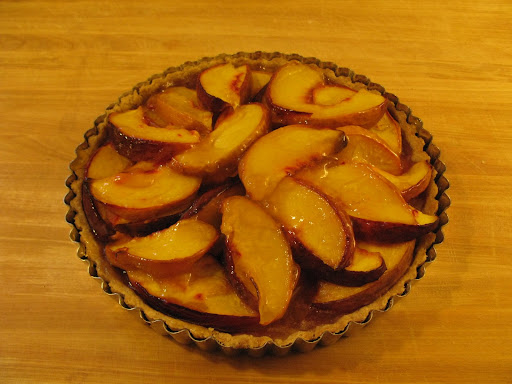
So here's a tart I made.
 When it comes to baking, I have learned that a scale is the most important thing. Measuring flour cannot be done perfectly without it. Flour can clump together, so you could essentially fit a lot more into a cup, but the scale will not lie to you. Also, with baking, having the perfect amount of some of these ingredients is essential. These recipes aren't thrown together, they have been perfected over centuries, so please get a scale.
So, the essential ingredients are pastry flour, sugar, chilled butter, salt, lemon zest, eggs, and a little water.
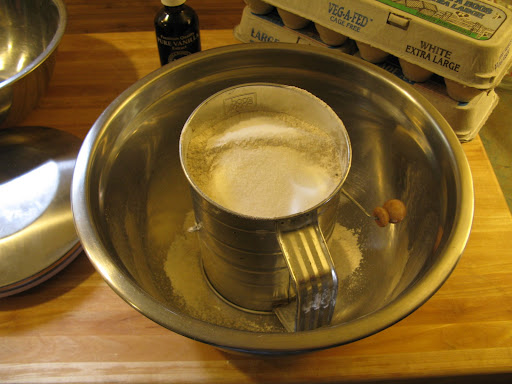 Here, I am going to make pâte brisée (translation: broken dough), which is a short dough, meaning it is high in shortening, or fat, or butter.
Sift the flour, sugar and salt together.

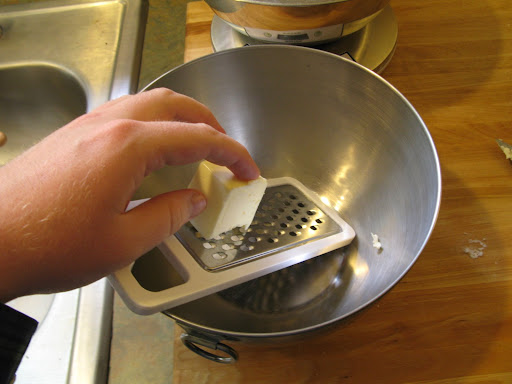
Now, take the butter (make sure it's cold), and break it up into small, pea-sized bits. Using a cheese grater helps a lot. My hands are quite warm, so if I broke it up with my fingers, it would melt, which I don't want to happen.
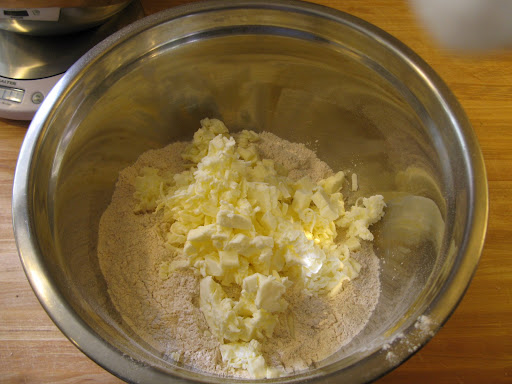 Add the cut butter to the flour, and mix with your fingertips, making sure to 'cut' the butter into the flour. This is basically making sure the butter is still in small, pea-sized bits, and not completely mixed with the dry ingredients.
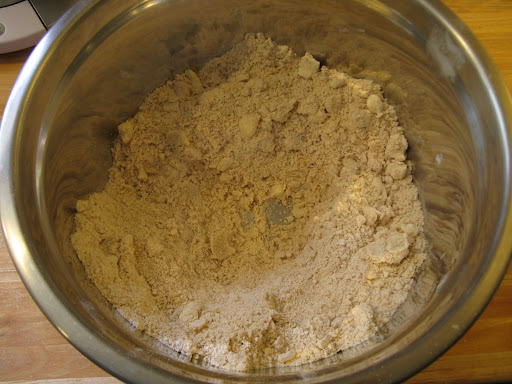
It should look like oatmeal, and there should be no big (bigger than a peanut) butter bits.
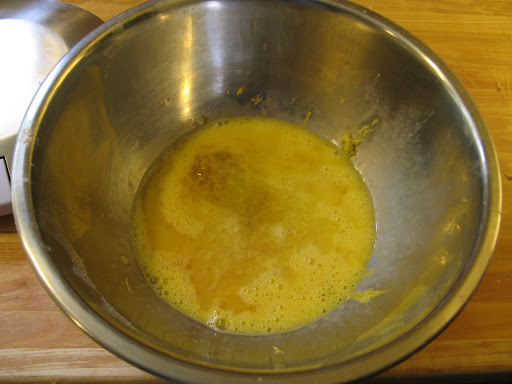 Now, mix the eggs, water, vanilla and lemon zest.
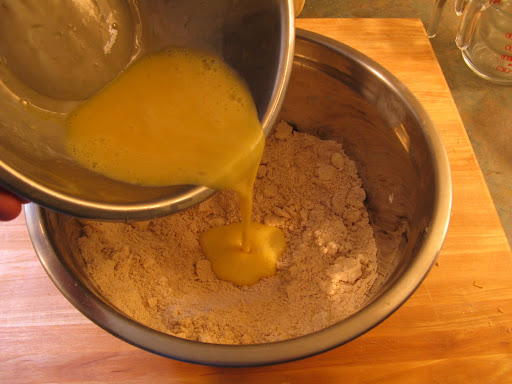 Make a well in the center of the dry ingredients, and pour in the wet.
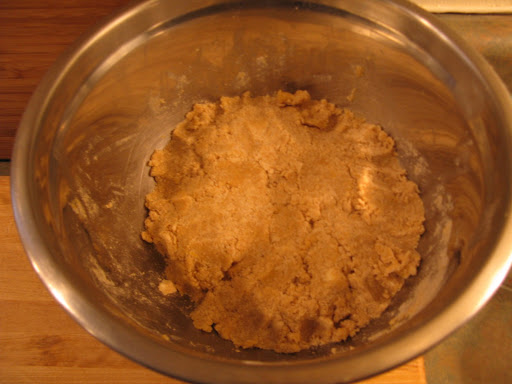 Mix lightly to make a soft dough. You don't need to completely mix it yet.
 Lay out the dough on a lightly floured surface, and knead a few times until it's completely mixed and holds its shape well.
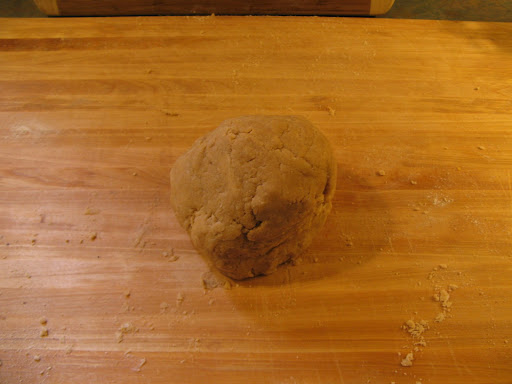 When it gets to the point that the ball feels greasy, stop, because that means you are melting the butter.
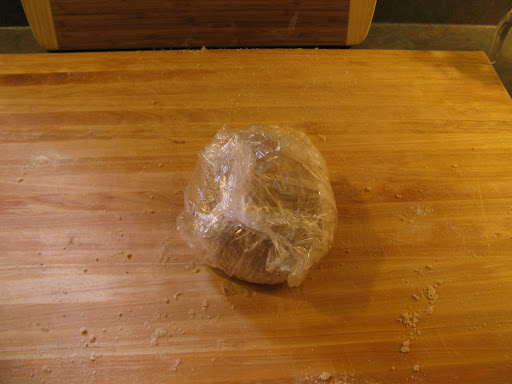 Now, wrap in plastic and put it in the refrigerator for at least a half hour.
... a half hour later ...
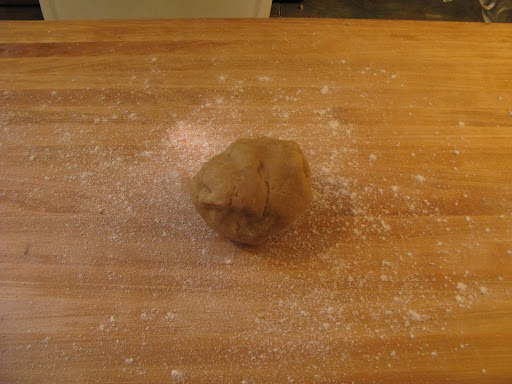 Lay your dough ball out on a floured surface. Let it sit for a few minutes to kind of warm up, so it's pliable, or mash it around in your hands for a few seconds.
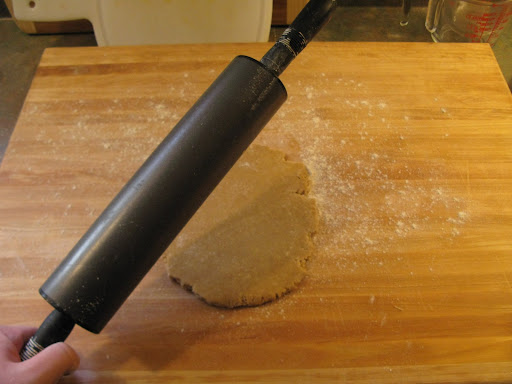 Pound it out and roll it out.
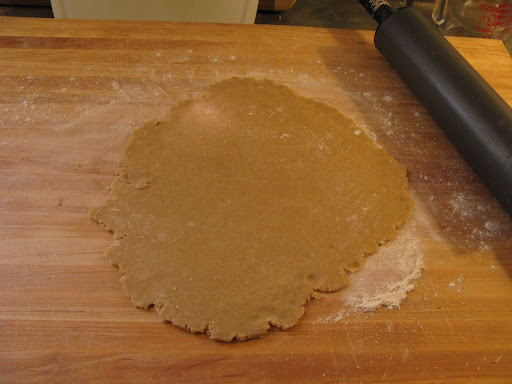 Pâte brisée should be rolled out to about 1/8 inch thick.
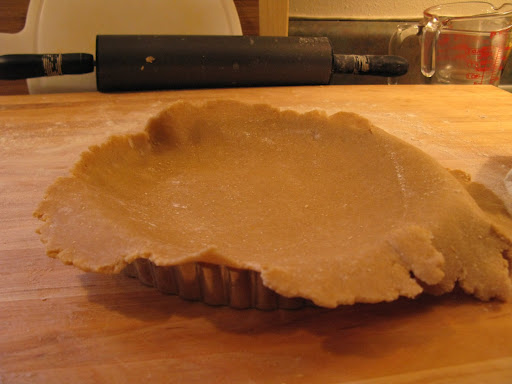
If you're having a hard time picking up the dough without breaking it, roll it around the rolling pin, and lay it on top of the tart pan.
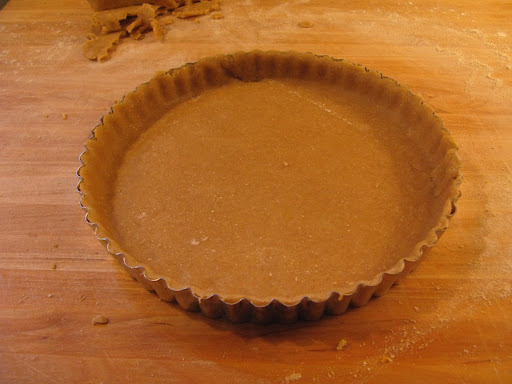
Don't stretch the dough, because it will shrink when you bake it. Lightly press the dough into the corners, and push it down over the edge of the pan to cut off the extra.
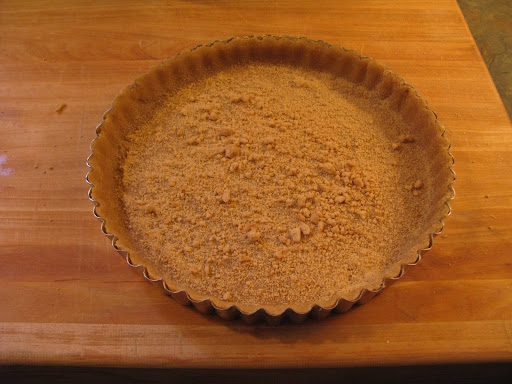
Now, line it with a layer of cookie crumbs to absorb the liquid that will come out of the fruit.
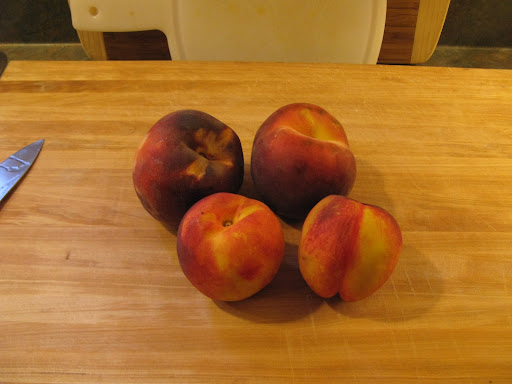 Here i've got some really nice peaches and apricots from the Portland Farmer's Market, which are delicious and in perfect season right now.
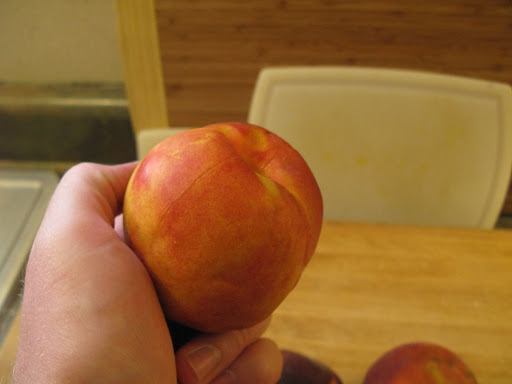 Slice the peaches and apricots around the pit to de-pit them.
 Slice them up!
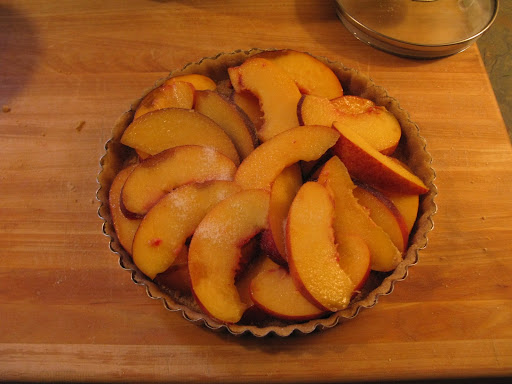
Lay the slices in the tart shell as decoratively as you can. The peaches here are the focus here, so it's ok if it looks a little 'rustic'.
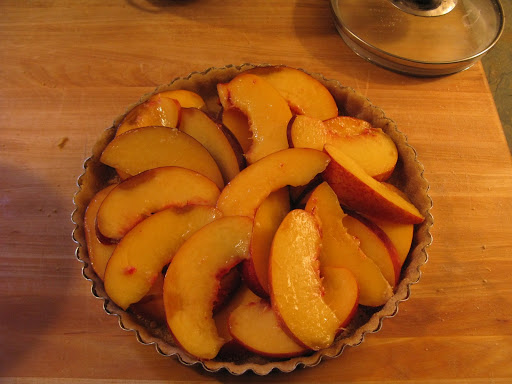 I put a few layers down, sprinkled some sugar over the top, put another layer in, and sprinkled some more sugar on top.
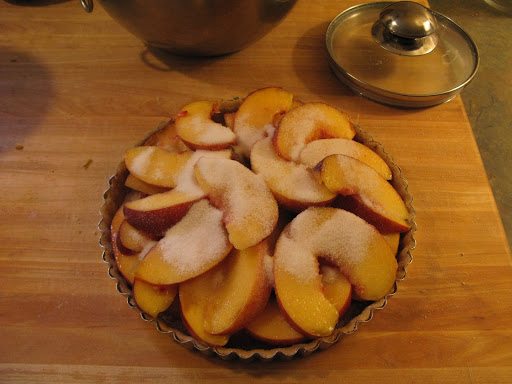
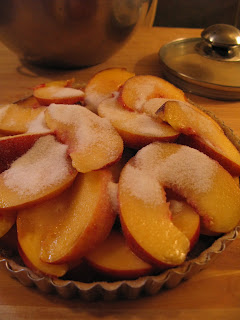
At this point, the tart makes itself.
Put it in the oven at 350 for 45 minutes. The fruit should get very tender and the dough should brown slightly.
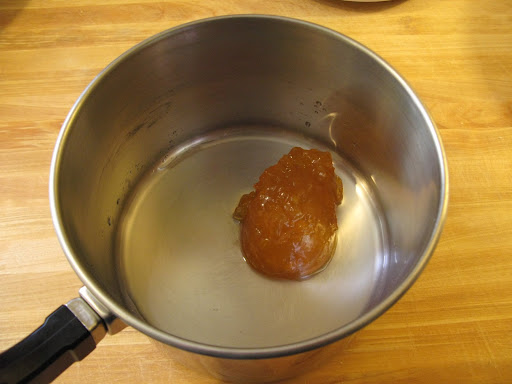
While it's baking, you can make the apricot glaze that goes on top, to make it more appealing and shiny.
You can use whole apricots, but i just bought some apricot preserves and melted them in a pan with some water.
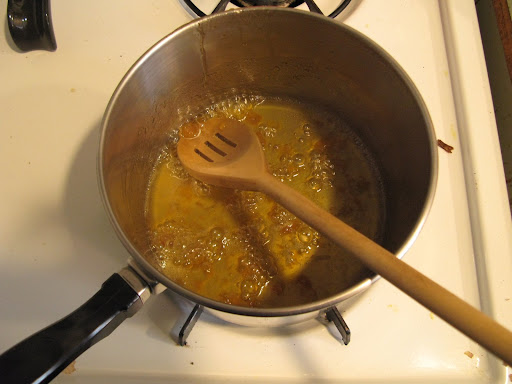
Bring it up to a boil, and when everything dissolves . . .
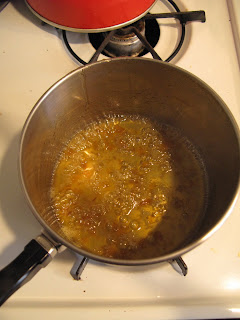
 Strain it.
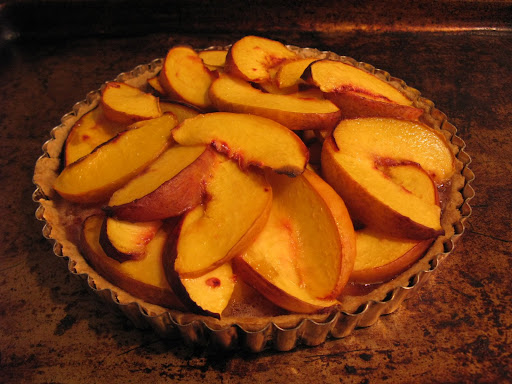 And it's baked!
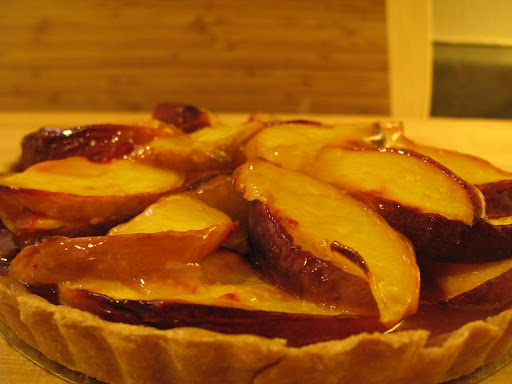
Just brush the apricot glaze on top.
It is September 4th, and next week I start International Cuisine; the last class (three weeks long) before the six weeks of Restaurant Practical. If you're in the Portland area, I recommend you come by the school restaurant, because I will either be cooking or serving.
But right now, I'm practicing my desserts for my final practical test for the school (which is in the first week of the Restaurant Practical).
So here's a tart I made.
 When it comes to baking, I have learned that a scale is the most important thing. Measuring flour cannot be done perfectly without it. Flour can clump together, so you could essentially fit a lot more into a cup, but the scale will not lie to you. Also, with baking, having the perfect amount of some of these ingredients is essential. These recipes aren't thrown together, they have been perfected over centuries, so please get a scale.
So, the essential ingredients are pastry flour, sugar, chilled butter, salt, lemon zest, eggs, and a little water.
 Here, I am going to make pâte brisée (translation: broken dough), which is a short dough, meaning it is high in shortening, or fat, or butter.
Sift the flour, sugar and salt together.

Now, take the butter (make sure it's cold), and break it up into small, pea-sized bits. Using a cheese grater helps a lot. My hands are quite warm, so if I broke it up with my fingers, it would melt, which I don't want to happen.
 Add the cut butter to the flour, and mix with your fingertips, making sure to 'cut' the butter into the flour. This is basically making sure the butter is still in small, pea-sized bits, and not completely mixed with the dry ingredients.
It should look like oatmeal, and there should be no big (bigger than a peanut) butter bits.
 Now, mix the eggs, water, vanilla and lemon zest.
 Make a well in the center of the dry ingredients, and pour in the wet.
 Mix lightly to make a soft dough. You don't need to completely mix it yet.
 Lay out the dough on a lightly floured surface, and knead a few times until it's completely mixed and holds its shape well.
 When it gets to the point that the ball feels greasy, stop, because that means you are melting the butter.
 Now, wrap in plastic and put it in the refrigerator for at least a half hour.
... a half hour later ...
 Lay your dough ball out on a floured surface. Let it sit for a few minutes to kind of warm up, so it's pliable, or mash it around in your hands for a few seconds.
 Pound it out and roll it out.
 Pâte brisée should be rolled out to about 1/8 inch thick.
If you're having a hard time picking up the dough without breaking it, roll it around the rolling pin, and lay it on top of the tart pan.
Don't stretch the dough, because it will shrink when you bake it. Lightly press the dough into the corners, and push it down over the edge of the pan to cut off the extra.
Now, line it with a layer of cookie crumbs to absorb the liquid that will come out of the fruit.
 Here i've got some really nice peaches and apricots from the Portland Farmer's Market, which are delicious and in perfect season right now.
 Slice the peaches and apricots around the pit to de-pit them.
 Slice them up!
Lay the slices in the tart shell as decoratively as you can. The peaches here are the focus here, so it's ok if it looks a little 'rustic'.
 I put a few layers down, sprinkled some sugar over the top, put another layer in, and sprinkled some more sugar on top.
At this point, the tart makes itself.
Put it in the oven at 350 for 45 minutes. The fruit should get very tender and the dough should brown slightly.
While it's baking, you can make the apricot glaze that goes on top, to make it more appealing and shiny.
You can use whole apricots, but i just bought some apricot preserves and melted them in a pan with some water.
Bring it up to a boil, and when everything dissolves . . .
 Strain it.
 And it's baked!
Just brush the apricot glaze on top.
Subscribe to:
Posts (Atom)