I have a few extra minutes, so I wanted to convey a little info about what I am doing right now.
Skills 1 and Sanitation are done with, and now i'm on to Nutrition. The classes are only three weeks long, so we go through things pretty fast. I got an A in skills and a pass in nutrition, so i'm perfect so far! I got a 95 on my cutting skills final test, which was basically what that picture was. I felt that my chateau potatoes were better on the test than in the picture, and i got a 7/10 on those. I'm not sure what the other two points were off on, but it might have been the julienne of carrot. I seem to cut them too small a lot of the time.
But nutrition. It is actually a lot better than you think. The instructor likes food, so she isn't going to tell us we shouldn't use butter because it has fat in it. Basically what it comes down to is that our diets should be diverse, and if you like something, eat it, just in moderation. Also (something I realized a few months ago), to maintain a healty lifestyle in a profession such as this, one needs to balance out the intake of a lot of less-healthy foods with a little bit of exercise. I started running a few months ago before I left Wyoming, but I had to stop because I had some shin splints issues. I really want to get back into that, so i'm going to try to get some better shoes, or maybe i'll find a different activity. I really don't want to join a gym because it's ridiculously expensive and I know I would hate being there.
I am throwing in little things here and there, though. Every day I walk up the stairs to class (five floors, tall ceilings, it's harder than you may think), and I try to take a brisk walk somewhere around town (it's a good excuse for me to look for a job). I am definitely feeling better about my health, but I know I need to do more. I had my blood pressure checked recently, and it's very good, so I think things are going pretty well.
Thursday, December 6, 2007


Sunday, December 2, 2007
Cooking Methods
Here's a chart of cooking methods we talked about a few days ago, so I wanted to transfer that on to all of you.

The history behind this is that braised meats are "peasant food." The tough, big cuts of meat (shoulder, rump meat) has always been cheaper than the prime cuts (prime rib, sirloin). In Europe, the elite, upper class would get the tender cuts of meat, where the farmers would get the cheaper, tougher items. These people were crafty, though. They had to find a way to make this tough items edible, and so braising was discovered.

Other important terms/info: Carmelization - This is the oxidation of sugar, and since sugar (in some form or another) is present in most everything, the cooking process turns them brown.
For blanquette, it says it must be finished creamy, but this doesn't mean add cream. You can make a sauce creamy by adding a starch, such as flour or corn starch.
Something I have discovered recently is that in Europe, braised and stewed dishes are more common than in the USA. Here in the US, big cuts of grilled, broiled meat are hugely popular. Also, grilling and broiling takes much less skill than braising.
The history behind this is that braised meats are "peasant food." The tough, big cuts of meat (shoulder, rump meat) has always been cheaper than the prime cuts (prime rib, sirloin). In Europe, the elite, upper class would get the tender cuts of meat, where the farmers would get the cheaper, tougher items. These people were crafty, though. They had to find a way to make this tough items edible, and so braising was discovered.
Here in the US, we have had much more accessibility to the tender cuts of meat, so they have become very popular and common at pretty much any restaurant.
I am a fan of big, tender cuts of meat, but over the last few years, the complexity of braised dishes excites me a lot more. I have found myself ordering a stew of rabbit, braised pork loin, and braised game hen knowing I will get a good sense of the chef's skill level.
For next time:
I'm thinking i'll do all the potato cuts. Also, Derek made a good point last time, he recomended I do an explanation of every knife, and its uses and how to use it, which is good! I want everybody to tell me what they want to see, and I will do my best to deliver.
For the knife demonstrations, I will get to that, but I can only do a few right now, but as I get into the meat and seafood classes, i'll do more.
Saturday, December 1, 2007
Julienne of carrot
The Julienne and Brunoise of Carrot
I'm going to do a few little picture demonstrations of some of the skills I learned. I am going to start with the Julienne of Carrot.

To begin, you will need a peeler and a large knife. Many people will use the regular French chef's knife, but for this task I like to use the Santoku chef's knife. I found that I can get a straighter, smoother cut with the santoku on the carrot and potato becuase the blade is thinner than the French chef's knife, and doesn't push the product apart as i cut through it.

Next, peel your carrot.

Then, cut your carrot into 2 1/2 inch segments. Start with the thicker end because then the remaining segment that didn't make the cut will be from the thinner end.
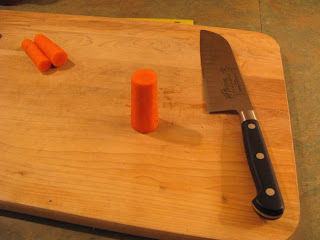
Trim the ends so they are flat and perfectly perpendicular to the rest of the segment.

Put the carrot down on the board, and slice off one side of the carrot, so it is perfectly flat.

Put the carrot down on the flat side you just cut and cut another side off, creating a perfect 90 degree angle where the two sides meet.

Then, slice off 1/8" thick by 2 1/2" long sheets from the carrot.


Next, take one of the sheets you just cut and cut off a 1/8" by 1/8" by 2 1/2" strip.

Continue until you have exhausted the sheet. Consistency is very important, so make sure they are all the same thickness.


Hold up your batch of julienne and eliminate those that are not even . . .

And turn the more inconsistent ones into brunoise. (1/8" cubes)

 Enjoy!
Any requests on what I demonstrate next? I am thinking about maybe zesting and segmenting an orange, but the other options are:
-julienne of bell pepper
-medium dice of an onion
-batonnet of celery
-chiffonade of spinach
-large, medium, small dice of potato
-chateau potato
-tomato concosse
I'm going to do a few little picture demonstrations of some of the skills I learned. I am going to start with the Julienne of Carrot.

To begin, you will need a peeler and a large knife. Many people will use the regular French chef's knife, but for this task I like to use the Santoku chef's knife. I found that I can get a straighter, smoother cut with the santoku on the carrot and potato becuase the blade is thinner than the French chef's knife, and doesn't push the product apart as i cut through it.

Next, peel your carrot.

Then, cut your carrot into 2 1/2 inch segments. Start with the thicker end because then the remaining segment that didn't make the cut will be from the thinner end.

Trim the ends so they are flat and perfectly perpendicular to the rest of the segment.

Put the carrot down on the board, and slice off one side of the carrot, so it is perfectly flat.
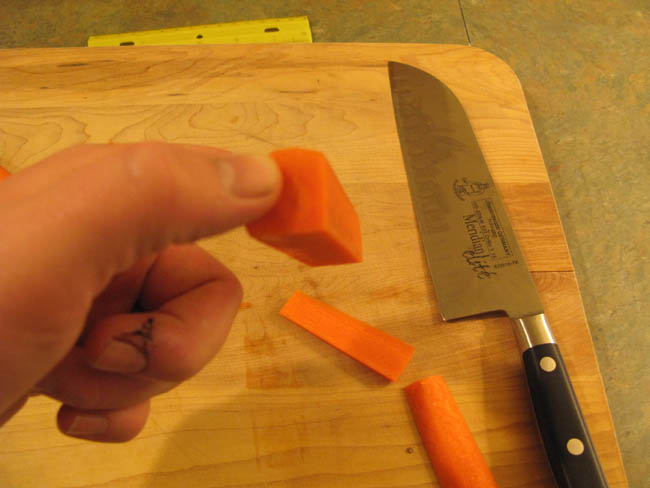
Put the carrot down on the flat side you just cut and cut another side off, creating a perfect 90 degree angle where the two sides meet.

Then, slice off 1/8" thick by 2 1/2" long sheets from the carrot.


Next, take one of the sheets you just cut and cut off a 1/8" by 1/8" by 2 1/2" strip.

Continue until you have exhausted the sheet. Consistency is very important, so make sure they are all the same thickness.

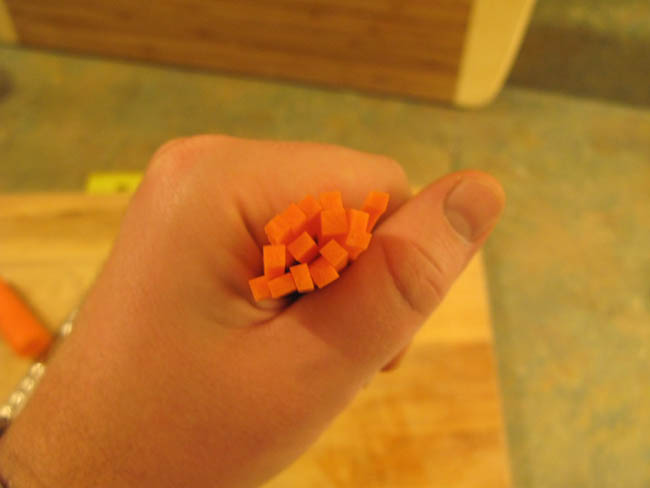
Hold up your batch of julienne and eliminate those that are not even . . .

And turn the more inconsistent ones into brunoise. (1/8" cubes)

 Enjoy!
Any requests on what I demonstrate next? I am thinking about maybe zesting and segmenting an orange, but the other options are:
-julienne of bell pepper
-medium dice of an onion
-batonnet of celery
-chiffonade of spinach
-large, medium, small dice of potato
-chateau potato
-tomato concosse
Subscribe to:
Posts (Atom)